Every pound on an electric vehicle costs range. Engineering teams running new EV programs are already running this math against every bracket, cover, and panel on the platform. The harder question is which thermoplastic, in which thickness, formed by which process, actually meets the specification without overbuilding. That decision usually plays out in pre-production with limited time and a tooling budget that has to survive the first production milestone.
PCI's documented belt guard conversion replaced a 718-pound steel guard with a 38-pound thermoformed ABS part for a heavy equipment OEM, a 95% weight reduction delivered three weeks ahead of a trade show debut. That kind of math is what makes heavy-gauge thermoforming the default conversation for large, low-to-mid-volume EV components today. The economics work because EV platforms are smaller than legacy automotive runs, tooling budgets are tighter, and geometry requirements favor large single-piece parts over multi-piece assemblies. And weight savings translate directly to range, which is the metric that sells the vehicle.
This guide walks through how to approach material selection for four EV applications where heavy-gauge thermoforming consistently outperforms the alternatives: battery enclosures, exterior body panels, interior trim and console housings, and charging station enclosures.
Why does material selection matter more for EV components than for legacy vehicles?
According to the U.S. Department of Energy's Vehicle Technologies Office, a 10% reduction in vehicle weight typically yields a 6–8% improvement in fuel economy. For battery-electric vehicles, that translates directly to driving range, the dominant performance metric for OEMs and consumers. A material substitution that takes 50 to 100 pounds out of a single component is no longer a nice-to-have. It is range booked against the vehicle's spec sheet.
EV programs also impose tests that legacy vehicle parts rarely faced. Battery enclosures need flame ratings under UL 94. Charging station housings need UV stability through five to ten years of outdoor exposure. Transit and shuttle interiors require flame-smoke-toxicity (FST) compliance under standards like ASTM E162 and ASTM E662, with NFPA 130 increasingly referenced for electric bus and rail applications. Specifying the right resin upfront is what keeps the program out of late-stage requalification.
Which polymers perform best for thermoformed battery enclosures?
Battery enclosures and pack covers are among the fastest-growing applications in heavy-gauge thermoforming, and the list of materials that consistently meets the specs is short.
If your application is an outer pack cover or accessory housing where ambient temperatures stay moderate, flame-retardant ABS is usually the right starting point. It carries a UL 94 rating, takes deep draws cleanly, and runs at lower material cost than polycarbonate.
If your application sits closer to the battery thermal management system or has to retain stiffness above 100°C, FR polycarbonate or PC/ABS blends are the better fit. Resin supplier technical data for FR polycarbonate grades, including SABIC Lexan FR-series and Covestro Makrolon FR grades, commonly list heat deflection temperatures above 130°C with UL 94 V-0 ratings at thicknesses suitable for thermoforming.
If your application requires both high impact performance and flame compliance, glass-reinforced PC/ABS extends the property envelope but requires forming experience because the material draws differently than unfilled grades.
The three datasheet numbers worth pulling on every candidate: UL 94 flame rating at the actual part thickness, heat deflection temperature, and notched Izod impact strength. Those three predict whether the part survives both the test lab and the road.
What materials work for EV exterior body panels?
Exterior panels for buses, delivery vans, shuttles, and last-mile EVs are the largest single category of heavy-gauge thermoformed parts in transportation. The challenge is balancing UV stability, impact resistance, paintability, and Class A surface quality on parts that can run six feet long or longer.
If your application is large lower-body cladding, fender extensions, or side panels where Class A finish is not required, TPO is hard to beat for UV stability and impact toughness at lower material cost.
If your application requires color and gloss retention through years of outdoor exposure, ASA/ABS or Korad-capped ABS is the right call. Both resist chalking and fade better than uncapped ABS, per manufacturer technical specifications for the cap layer chemistry.
If your application is a transparent or translucent panel, including light covers or signage elements, UV-resistant polycarbonate carries both the optical clarity and the impact performance.
PCI's UltraTuf polycarbonate sheeting and FormPro ABS sheeting are engineered specifically for these EV exterior applications, with material properties tuned for the weight reduction targets battery-powered platforms demand.
How should engineers select materials for EV interior trim and operator console housings?
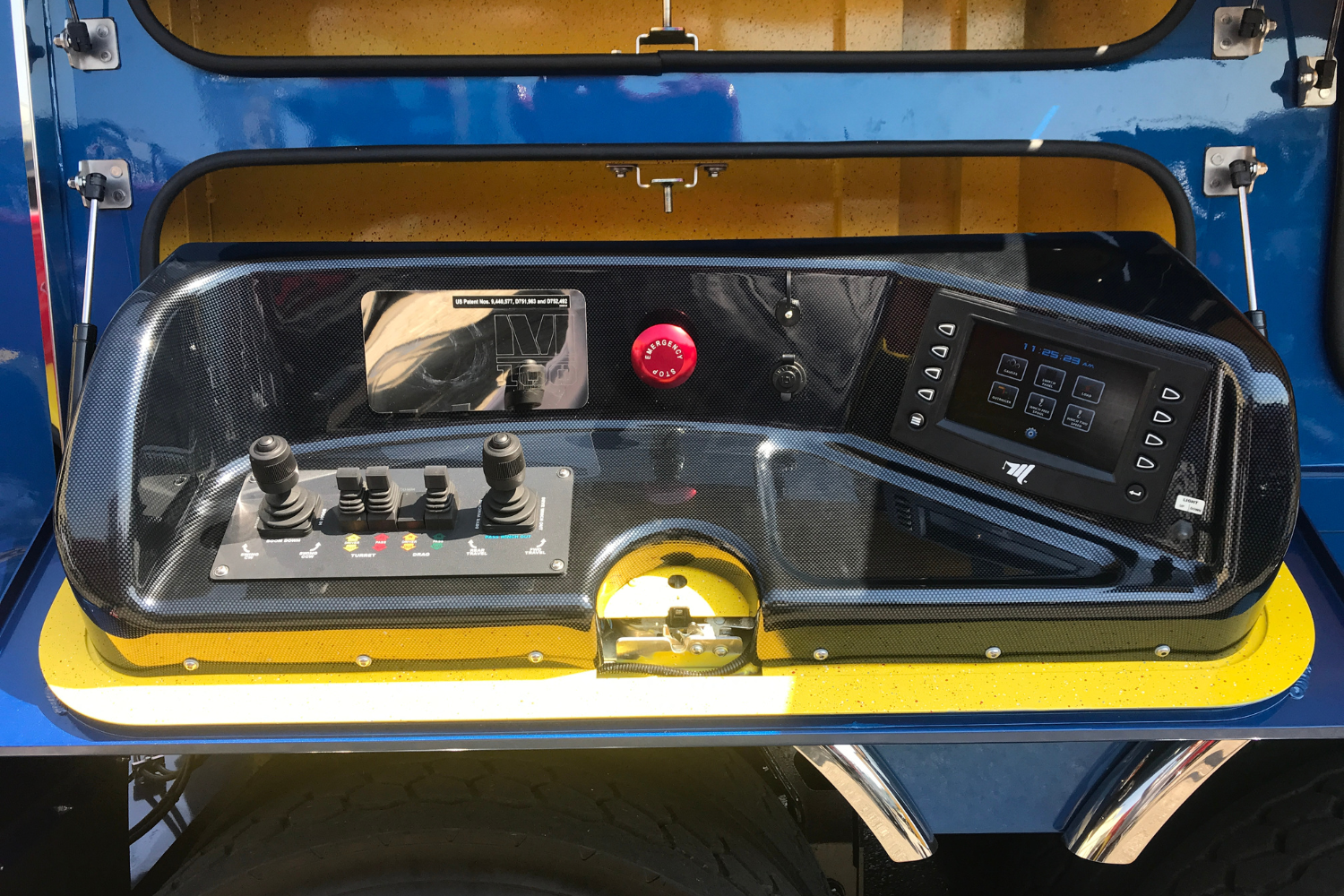
Interior components in transit buses, shuttles, and operator-controlled EVs face a different specification set: flame, smoke, and toxicity ratings, cleanability, and surface durability across long service lives. KYDEX thermoplastics dominate this category because the family includes a grade for almost every interior decision an EV engineer will face.
If your application is a decorative interior panel that has to meet FMVSS 302 and FAR 25.853 flammability, start with KYDEX T. It accepts deep draws and crisp surface detail, which matters when logos or branding are formed into the part.
If your application is a high-traffic operator station, seat back, or component that takes regular impact, KYDEX 100 and 110 add impact resistance without losing the flame rating. KYDEX 110 specifically is engineered for higher-wear environments, per Sekisui SPI's published material data.
If your application is a shared-fleet vehicle where surface hygiene matters operationally, including transit buses, ride-share EVs, and last-mile delivery cabs, KYDEX ION antimicrobial grades build the antimicrobial property into the resin rather than applying it as a coating, so the protection persists for the part's service life.
For mass transit specifically, confirm NFPA 130 compliance with the resin supplier on the actual grade and thickness specified. The standard governs fixed guideway transit and is increasingly applied to electric bus and shuttle programs.
What materials suit charging station enclosures and equipment housings?
Public and fleet charging stations are outdoor electrical equipment, which makes UV stability, weather resistance, and flame ratings the dominant material criteria.
If your application is a Level 2 outdoor housing, UV-stabilized ASA/ABS handles years of sun, rain, and temperature cycling without warping or losing color. It is also paintable for fleet branding.
If your application is a DC fast-charging cabinet with significant internal heat load, FR polycarbonate or glass-filled PC/ABS provides better dimensional stability above 100°C than uncapped ABS.
If your application is the lower portion of a charging pedestal that takes vehicle, cart, and snow-equipment impact, HMWPE (high molecular weight polyethylene) is the impact specialist. Manufacturer datasheets confirm exceptional abrasion resistance and a coefficient of friction comparable to PTFE.
The supply chain factor on charging infrastructure is real. Plastics News has reported on the 15% tariff applied to Korean ABS imports, which has shifted sourcing economics toward domestic thermoforming for North American charger deployments.
How does thermoforming compare to alternative processes for EV components?
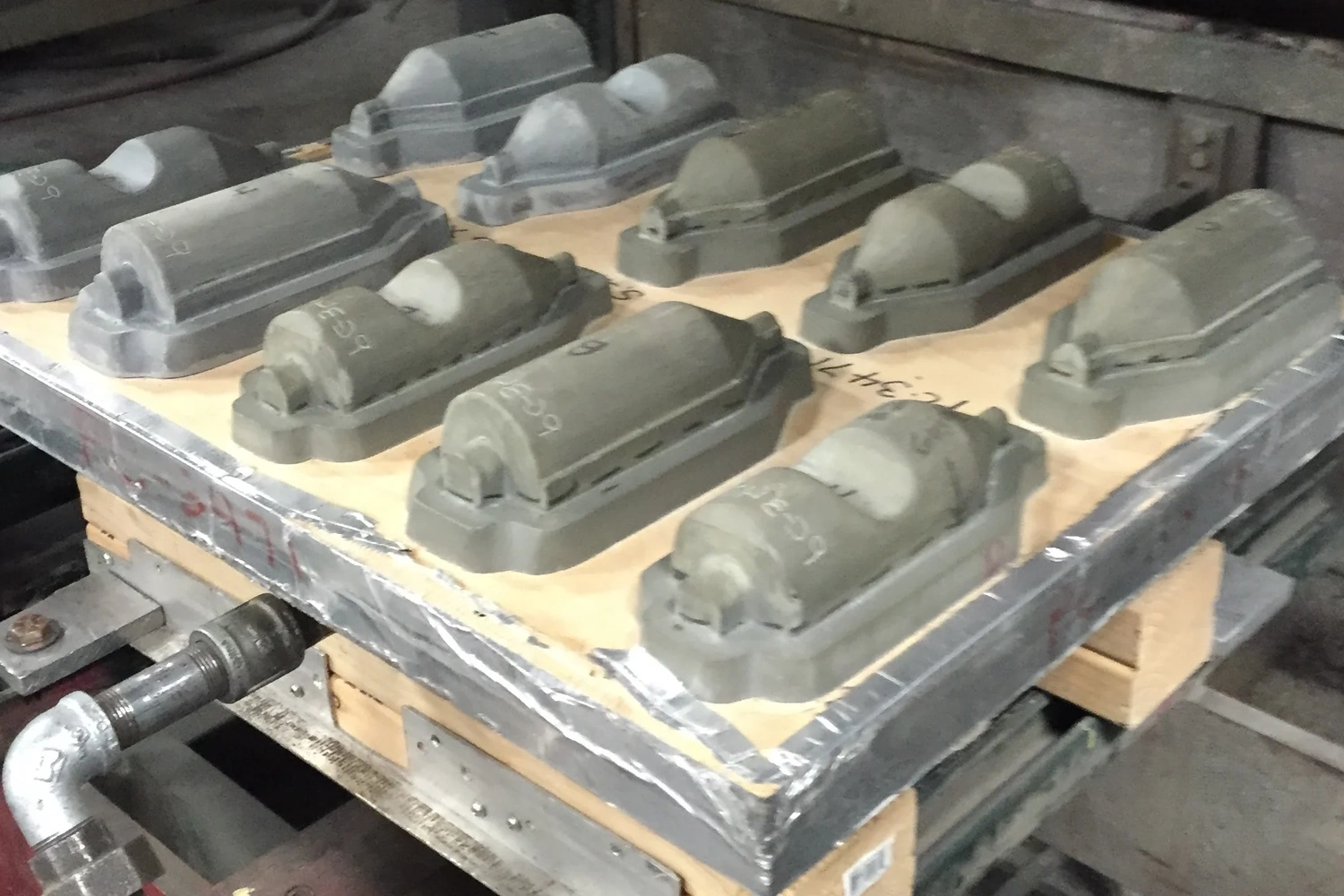
Heavy-gauge thermoforming typically wins on tooling economics for EV programs running production volumes from the low hundreds into the low thousands of parts per month. PCI documents thermoforming tooling at approximately 10–15% of the cost of equivalent injection molding tooling, with first-article prototypes commonly delivered in 15–20 working days versus several months for steel injection molds. For EV startups and lower-volume programs in mass transit and specialty vehicles, that lead-time advantage is often the difference between hitting a launch window and missing it.
The honest tradeoff is volume. As sustained production climbs and parts run identical for years, injection molding's lower per-part cost starts to outweigh thermoforming's tooling advantage. The crossover point depends on part size, geometry, and resin choice, which is why a part-specific cost model from a thermoformer who can frame both processes is more useful than a generic comparison.
Frequently Asked Questions
What is the maximum part size for heavy-gauge thermoforming in EV applications?
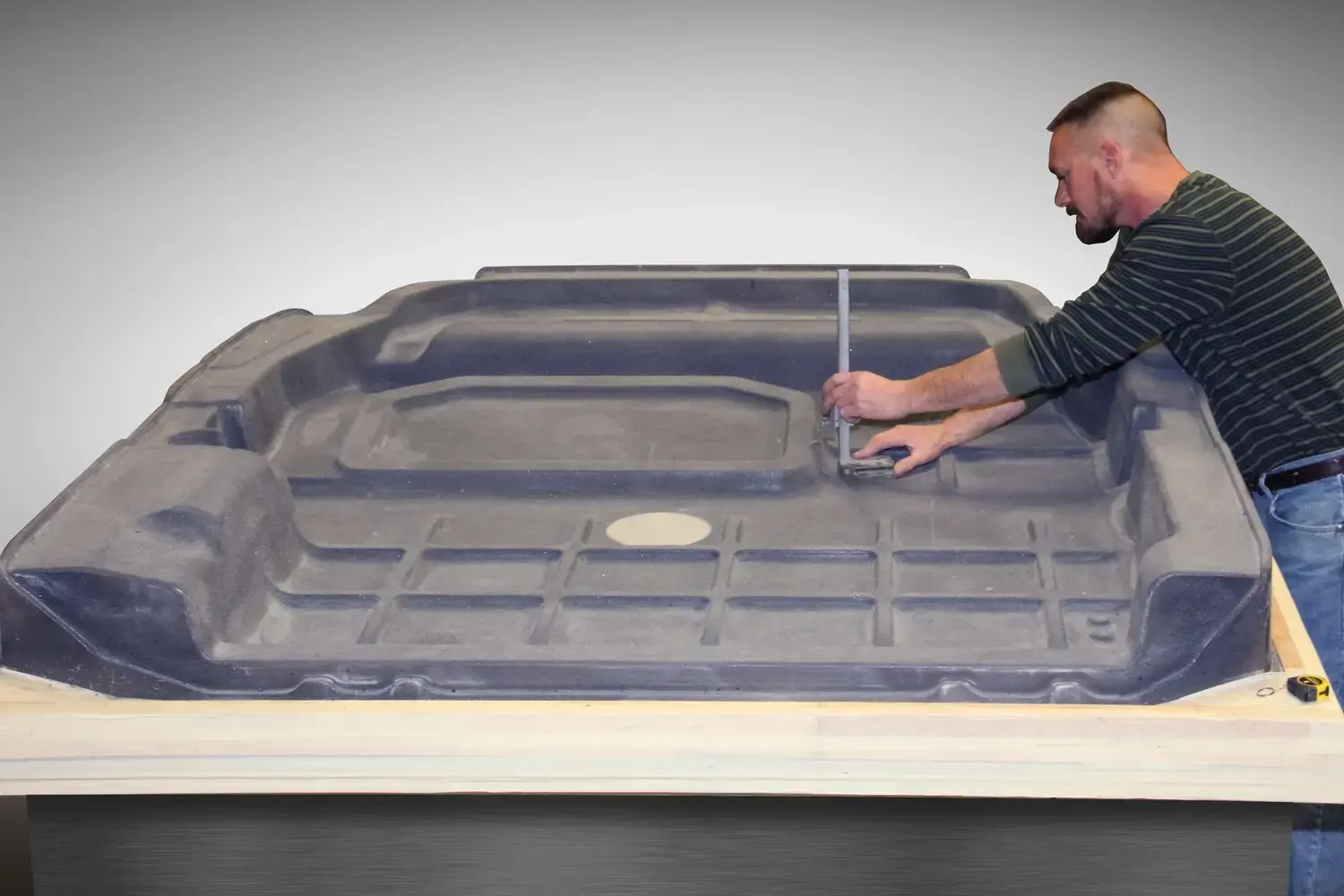
Heavy-gauge thermoforming machines commonly form parts up to 6 feet by 10 feet, with sheet thicknesses ranging from 0.060 to 0.500 inch. That envelope covers most full-size battery pack covers, bus side panels, and large interior trim components as single-piece parts.
Are thermoformed plastics structurally adequate for EV battery enclosures?
Thermoformed plastic enclosures are typically used as covers, shields, and outer housings rather than primary structural members. The structural battery tray itself is usually metal. Thermoplastic covers carry impact, environmental, and flame loads, which they handle effectively with the right resin specified.
Do thermoformed plastic parts meet automotive flammability standards?
Per material manufacturer specifications, select grades of ABS, polycarbonate, KYDEX, and PC/ABS blends meet FMVSS 302, UL 94 V-0 or V-2, and FST standards including ASTM E162 and E662. The right material has to be matched to the specific test the application must pass.
How long does prototype tooling take for an EV thermoformed part?
Heavy-gauge thermoforming first-article prototypes commonly run 15–20 working days, compared to several months for injection molding tooling. That speed advantage is a primary reason EV programs use thermoforming for early validation builds.
What is the typical production volume range where thermoforming makes economic sense?
Heavy-gauge thermoforming is most economical for production volumes from the low hundreds into the low thousands of parts per month, depending on part size and geometry. Below that range, machined or fabricated parts may be appropriate. Above it, injection molding starts to win on per-part cost.