Engineers running heavy equipment, agricultural, and specialty vehicle programs already know fiberglass is heavier than thermoformed plastic. What gets missed in the spec review is how much heavier, how much more variable part-to-part, and how much of the program's lead time and labor cost gets absorbed by the layup shop. On a typical heavy equipment hood that weighs 60 pounds in fiberglass, the same part in thermoformed ABS lands closer to 30 pounds at equivalent stiffness. Across a full cab panel set, the cumulative weight reduction can exceed 100 pounds per vehicle.
Thermoformed plastic is typically 40–50% lighter than fiberglass, with better part-to-part consistency, faster production cycles, cleaner trim quality, and fewer regulatory exposure concerns. Fiberglass can still make sense for very low-volume programs, extreme compound curves, existing tooling, or field repairability, but most heavy equipment, agricultural, and specialty vehicle applications favor heavy-gauge thermoforming for weight, repeatability, lead time, and total cost.
Heavy-gauge thermoforming has become the default fiberglass-to-plastic conversion path for these programs because the math works on weight, repeatability, lead time, and total cost. The honest tradeoff: fiberglass still has a place at very low volumes and on geometries thermoforming cannot reach. For everything in between, the comparison favors thermoformed plastic.
This post walks through how fiberglass and heavy-gauge thermoforming actually compare on weight, repeatability, surface quality, regulatory exposure, and lead time, with a focus on heavy equipment cabs, agricultural panels, and specialty vehicle upfitter applications.
Why are engineers replacing fiberglass with thermoformed plastic?
The case for fiberglass-to-plastic conversion comes down to four issues that show up consistently in heavy equipment and specialty vehicle programs.
The first is weight. Thermoplastics typically weigh 40–50% less per unit volume than glass-reinforced fiberglass laminates, according to published material density data. That difference compounds across a full set of cab panels, hoods, and fender extensions.
The second is part-to-part consistency. Hand-laid fiberglass varies in thickness, glass content, and resin distribution from one operator and one part to the next. Heavy-gauge thermoforming uses extruded sheets of consistent thickness, formed under controlled vacuum or pressure, which produces parts that are dimensionally repeatable across a production run.
The third is lead time. Heavy-gauge thermoforming first-article prototypes typically take 15–20 days, while production parts come off the same tooling in hours, not days. Fiberglass cycle times are constrained by cure schedules and post-mold finishing labor, which has only become harder to staff.
The fourth is environmental and operator exposure, which has become a procurement risk topic in its own right. Open-mold fiberglass production releases styrene, which OSHA classifies as a regulated air contaminant with a permissible exposure limit of 100 ppm over an eight-hour shift. EPA's National Emission Standards for Hazardous Air Pollutants for reinforced plastic composites production, codified at 40 CFR Part 63 Subpart WWWW, imposes ongoing compliance overhead on fiberglass operations. The combined effect of OSHA exposure rules, EPA emissions compliance, and a broader labor shortage in hand-layup work has tightened fiberglass capacity and stretched lead times for many supply chains. Project managers evaluating supplier risk on fiberglass-sourced components should factor that into the conversation. Thermoforming uses solid sheet, produces no styrene emissions, and runs in a fundamentally different regulatory and labor environment.
How does fiberglass compare to thermoplastic on weight?
The density math explains why thermoforming wins on weight. Hand-laid fiberglass with 30–40% glass content typically runs 1.5–1.9 g/cm³, per fiberglass industry technical data. Common thermoforming resins land well below that range. ABS sits at roughly 1.04 g/cm³. HDPE and HMWPE run 0.94–0.95 g/cm³. TPO runs 0.90–0.95 g/cm³. Polycarbonate is heavier at 1.20 g/cm³ but still lighter than fiberglass.
For an equivalent panel geometry, a thermoformed ABS or HMWPE part typically lands 40–50% lighter than the same part in fiberglass. On a heavy equipment hood or operator cab roof panel running 30–60 pounds in fiberglass, that is 12 to 30 pounds removed per part without changing geometry, function, or fit. Across a full vehicle bill of materials, the cumulative savings show up in payload capacity, fuel economy, and assembly handling time.
What about surface finish, repeatability, and trim quality on thermoformed heavy equipment panels?
Fiberglass parts come out of the mold needing finish work. Print-through, pinholes, fiber show, and uneven edges are typical, and the gel-coat or paint finish has to cover them. Every part takes labor time to make presentable.
Thermoformed parts come off CNC trim with a consistent A-side surface and clean cut edges. Pressure-formed parts hit textured or molded-in detail with crisp definition, including logos and identifying marks that fiberglass cannot reliably reproduce part-to-part. The A-side surface inherits whatever texture or color is in the sheet, so a textured ABS sheet produces a textured finished part with no secondary work.
Repeatability matters when the panel is part of a larger assembly. Heavy equipment OEMs and specialty vehicle upfitters running hundreds of nearly identical builds need each panel to fit the same way, every time, without trim adjustments at the line. Thermoforming delivers that. Hand-laid fiberglass, by its nature, does not.
Where does fiberglass to plastic conversion make the strongest case?
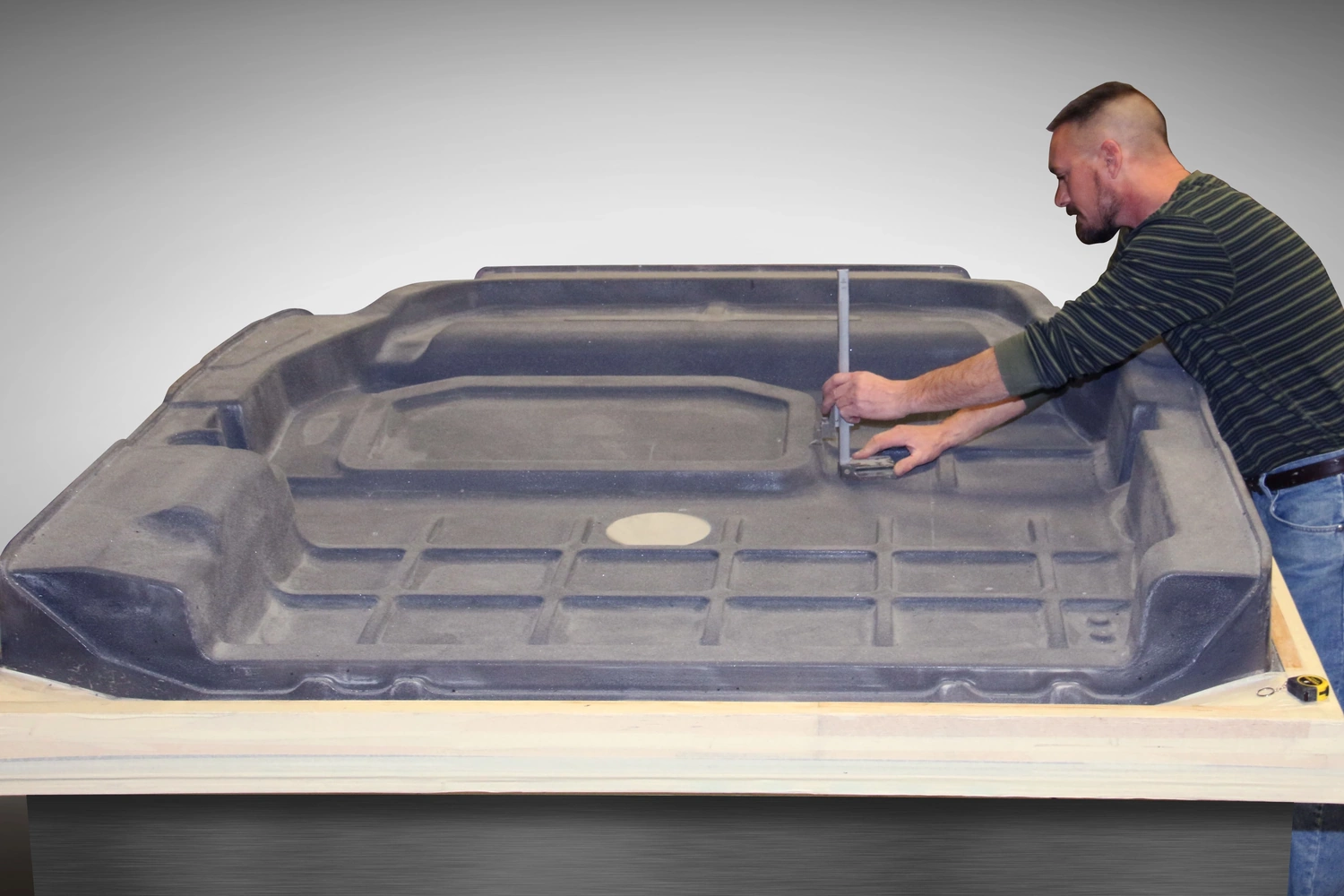
Heavy equipment and agricultural cab applications are among the strongest fiberglass-to-plastic conversion candidates. Operator station roofs, side panels, hoods, and fender extensions run large enough to benefit from heavy-gauge thermoforming's 6-foot by 10-foot forming envelope and 0.060- to 0.500-inch sheet thickness range. The parts often see UV exposure, weather, and impact, all of which UV-stabilized ABS, ASA/ABS, polycarbonate, and HMWPE handle well per material manufacturer specifications.
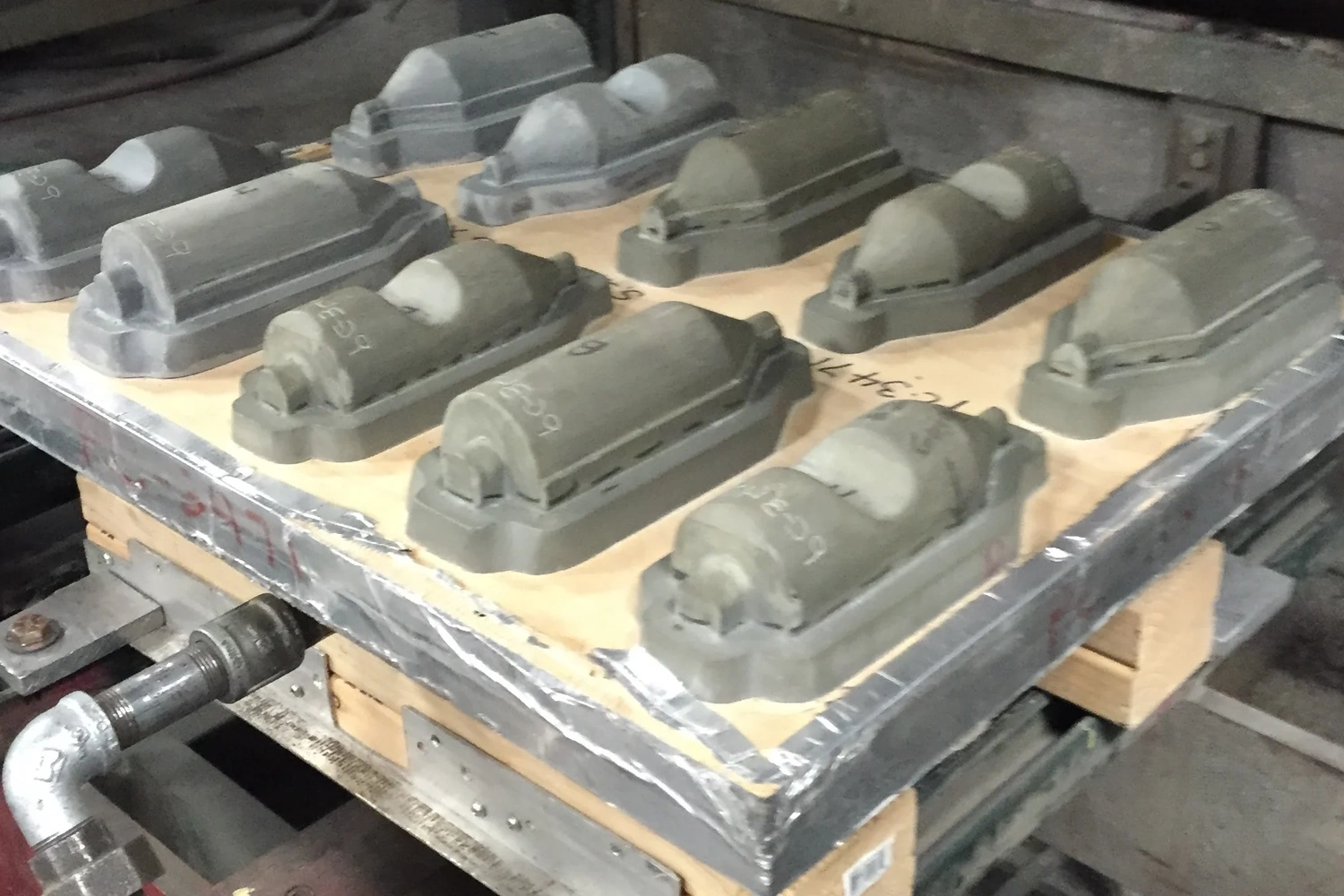
Specialty vehicle upfit work is the other strong category, including work truck bodies, emergency vehicle panels, utility van conversions, and service body components. Upfit programs run in the dozens to low thousands per year, which is exactly the volume range where heavy-gauge thermoforming's tooling economics outperform both fiberglass and injection molding. PCI documents thermoforming tooling at approximately 10–15% of the cost of equivalent injection molding tooling, with similarly favorable economics versus matched-mold compression fiberglass tooling.
The supply chain factor is also worth naming. Plastics News has reported on the 15% tariff applied to Korean ABS imports, which has shifted sourcing economics toward domestic thermoforming for North American heavy equipment and specialty vehicle programs.
When does fiberglass still win against thermoforming?
Fiberglass has its applications, and pretending otherwise hurts credibility. Four situations come up consistently where fiberglass remains the right choice or at least a defensible one.
Very low production volumes are the clearest case. A program running fewer than 25 to 50 parts per year cannot amortize thermoforming tooling, and hand-laid fiberglass with simple male or female tooling can be the cost-effective answer.
Extreme compound curves and deep draws sometimes exceed thermoforming's draw ratio limits. Pressure forming captures most geometries that vacuum forming cannot, but a few extreme designs are still better suited to fiberglass layup, where the operator can build material into tight pockets and complex curves.
Existing tooling investment matters in the real world. A program with mature fiberglass tooling and a stable supplier may not have the budget to recapitalize tooling mid-platform, even when a future redesign would warrant the switch.
Field repairability is the last consideration. Fiberglass parts can be patched in the field by a technician with a kit. Thermoformed parts that take significant damage typically need replacement. For equipment running in remote service environments, that distinction can matter to total cost of ownership.
Outside those edges, fiberglass-to-plastic conversion math favors thermoforming.
Frequently Asked Questions
How much weight can I save by converting from fiberglass to thermoformed plastic? Weight savings depend on part geometry and resin choice, but thermoformed plastic typically runs 40–50% lighter than equivalent hand-laid fiberglass per unit volume. On a 50-pound fiberglass panel, that translates to 20 to 25 pounds removed per part.
Are thermoformed plastic panels as durable as fiberglass for heavy equipment applications? Thermoformed parts in materials like HMWPE, polycarbonate, and impact-modified ABS can match or exceed fiberglass on impact, abrasion, and chemical resistance, depending on resin selection. Material manufacturer datasheets list specific impact strength and chemical resistance values to validate against application requirements.
What is the typical lead time difference between fiberglass and thermoformed parts? Heavy-gauge thermoforming first-article prototypes commonly run 15–20 working days. Fiberglass tooling and prototype timelines vary widely with shop capacity but generally run longer due to cure cycles and finish labor. Production cycle time per part is also faster for thermoforming once tooling is in place.
Can thermoformed parts replace fiberglass on parts with deep draws or compound curves? Most fiberglass panel geometries fall within heavy-gauge thermoforming's draw ratio capabilities. Pressure forming uses up to roughly 60 psi of forming pressure compared to vacuum forming's atmospheric ceiling near 14.7 psi, capturing deeper detail and tighter geometry than vacuum alone. A thermoformer experienced in pressure forming can usually quote any fiberglass geometry that is not at the extreme edge of the design envelope.
How does the tooling cost for thermoforming compare to compression-molded fiberglass? Heavy-gauge thermoforming tooling typically runs at a fraction of the cost of matched-mold compression fiberglass tooling, with shorter build time. PCI documents thermoforming tooling at approximately 10–15% of equivalent injection molding tooling cost, and the gap to fiberglass matched-mold tooling is similarly favorable.
Send your existing fiberglass parts, drawings, or solid models to PCI for a fiberglass-to-thermoforming conversion quote. The team will evaluate weight savings, material options, and tooling timeline against your program's specific requirements.