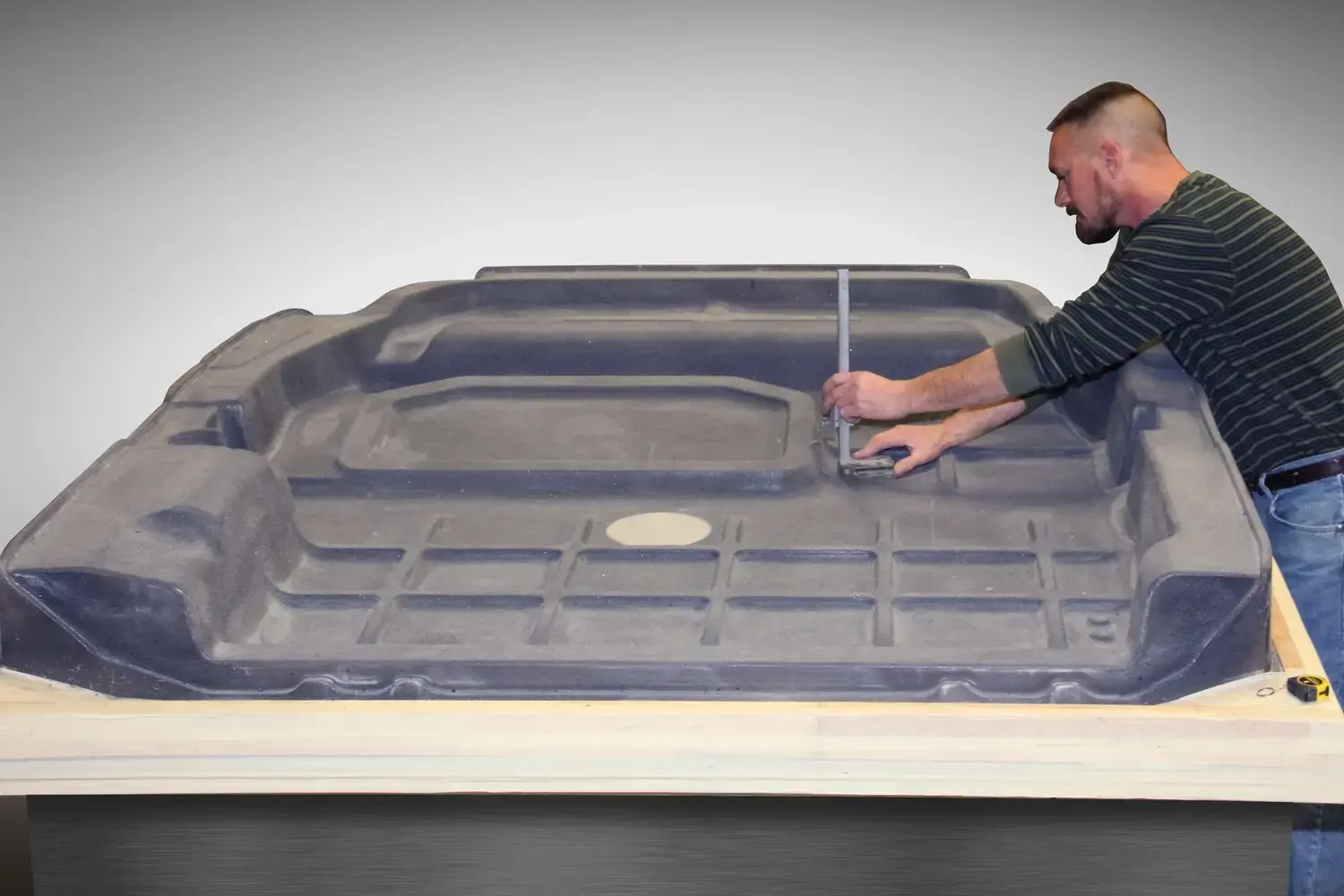
Thermoformed medical device components face unique challenges in achieving fingerprint resistance. The lower forming pressures limit texture depth transfer, while the larger part sizes typical of thermoforming make uniform texture more difficult to achieve than in injection molding. However, thermoforming's material options and ability to use pre-textured sheets provide alternative strategies for managing fingerprint visibility.
Medical equipment manufacturers increasingly specify thermoformed components for housings, covers, and control panels due to lower tooling costs and faster development cycles. Understanding how to achieve effective fingerprint resistance within thermoforming's capabilities ensures these components meet both aesthetic and hygiene requirements in clinical environments.
Why Do Fingerprints Show on Medical Equipment Touchscreens and Controls?
Fingerprint visibility on medical devices creates perception and hygiene challenges in clinical environments. When anesthesia machine controls show every fingerprint after one surgery, or ultrasound keyboard bezels look contaminated despite regular cleaning, the problem stems from surface finish specifications that didn't account for thermoforming's texture transfer limitations.
Fingerprints consist of sebaceous oils, amino acids, and salts that create refractive index differences on smooth surfaces. These deposits become visible when light reflects differently from contaminated versus clean areas. Glossy surfaces show the worst fingerprint visibility because the high contrast between specular reflection and diffuse scattering makes every contact point obvious.
Hospital environments amplify the problem through frequent hand sanitizer use, which increases oil transfer from skin while making fingerprints more difficult to remove. The alcohol in sanitizers partially dissolves skin oils, creating a sticky residue that bonds more aggressively to smooth plastic surfaces than normal fingerprints. Thermoformed parts with limited texture depth face greater challenges than injection molded components in hiding this contamination.
How Does Surface Roughness Reduce Fingerprint Visibility on Different Plastics?
Surface roughness achievable through thermoforming—typically 0.5-2.0 micrometer Ra—can still effectively reduce fingerprint visibility when properly implemented. The key lies in understanding that optical diffusion, not contamination prevention, hides fingerprints from view.
Reducing gloss from 80 units (polished) to below 25 units eliminates 60-70% of fingerprint visibility under typical hospital lighting—achievable even with thermoforming's texture limitations. When incident light hits a textured surface, it scatters in multiple directions rather than creating mirror-like reflection. This scattering averages out the refractive index differences between clean and contaminated areas.
Texture depth between 60-100 micrometers on formed parts provides optimal fingerprint hiding for thermoformed medical surfaces. Achieving this requires tool textures of 100-150 micrometers in pressure forming or 120-180 micrometers in vacuum forming. This range balances visibility reduction against cleanability—deeper textures trap contamination while shallower patterns don't scatter light effectively.
Polycarbonate for Medical Thermoforming
Polycarbonate thermoforms well and maintains fingerprint resistance through repeated hospital cleaning. Pressure forming PC at 60 psi against textured aluminum tools achieves 65-70% texture transfer, sufficient for effective fingerprint masking. The material's chemical resistance means quaternary ammonium cleaners don't degrade the textured surface over thousands of cleaning cycles. Pre-drying for 8 hours at 120°C is essential to prevent hydrolysis that creates surface irregularities affecting both appearance and cleanability.
ABS Applications
ABS provides good fingerprint resistance at lower cost than PC when properly textured. Pressure forming is recommended—vacuum forming's limited pressure struggles to replicate textures above 60 micrometers depth. Using pre-textured ABS sheet with embossed patterns provides consistent fingerprint resistance independent of tool texture, though at 15-20% higher material cost. The material's lower chemical resistance requires validation with specific hospital disinfectants.
PETG Benefits
PETG offers an excellent balance for thermoformed medical components. The material pressure forms well, achieving 60-65% texture transfer at moderate forming temperatures. Pre-dried PETG (4 hours at 65°C) accepts texture depths to 80 micrometers without excessive thinning. The material's clarity makes it ideal for backlit control panels where fingerprint resistance matters but light transmission is critical. Consider that texture reduces light transmission by 10-15%—factor this into backlight design.
Which Mold Texturing Method Works Best for Healthcare Applications?
Healthcare applications demand validated, repeatable texturing processes that deliver consistent fingerprint resistance across production runs. Thermoforming tools offer different texturing options than injection molds, with considerations for larger surface areas and lower production volumes.
Chemical Etching
Chemical etching delivers cost-effective fingerprint resistance for thermoformed medical components. The random pattern naturally masks fingerprints, while the 100-150 micrometer tool texture depth (yielding 60-100 micrometers on parts) provides adequate light scattering. Etch depth control within ±20 micrometers is achievable through careful process control. Documentation for validation requires statistical sampling across tool surfaces. The organic appearance works well for handheld devices and portable equipment where users expect a softer feel. Large thermoforming tools benefit from chemical etching's ability to texture substantial areas uniformly.
Bead Blasting
Bead blasting creates uniform matte finishes ideal for large thermoformed medical housings. Using 150-220 grit media produces consistent 20-30 gloss unit surfaces on formed parts. The process suits thermoforming's typical aluminum tooling, creating 80-120 micrometer texture that transfers to 50-80 micrometers on formed parts. Media selection affects final appearance—glass beads create softer texture while aluminum oxide produces more aggressive light scattering. Healthcare keyboard bezels and equipment panels commonly use bead-blasted textures for uniform appearance and fingerprint resistance.
Laser Texturing
Laser texturing provides precision for validated medical device processes but at higher cost. The digital control ensures repeatability within ±10 micrometers—important for FDA submissions. Programming 100-140 micrometer tool depths accommodates thermoforming's partial transfer while achieving target fingerprint resistance. Gradient textures transition from aggressive anti-fingerprint zones to smooth areas for displays or labels. The higher cost (3-4x chemical etching) limits use to critical touch zones rather than entire tool surfaces.
Pre-Textured Sheet Materials
Pre-textured sheet materials offer the most consistent fingerprint resistance for thermoformed medical parts. Embossed sheets with controlled texture eliminate uncertainty about tool texture transfer. Materials like textured PETG or PC provide reliable 25-35 gloss units and proven fingerprint resistance. While adding 20-30% to material cost, pre-textured sheets reduce validation complexity and ensure batch-to-batch consistency crucial for medical devices.
What Anti-Fingerprint Coatings Actually Work on Thermoformed Medical Parts?
Anti-fingerprint coatings provide additional protection beyond texture, particularly important when thermoforming's texture limitations need supplementation. These treatments work synergistically with achievable surface roughness to minimize fingerprint visibility.
Hydrophobic Fluoropolymer Coatings
Hydrophobic fluoropolymer coatings reduce fingerprint adhesion effectively on thermoformed parts. The lower surface roughness of thermoformed components (compared to injection molded) actually improves coating uniformity. Oils bead up on the low-energy surface rather than spreading. Application via spray coating accommodates thermoforming's typically larger parts better than dip coating. The coatings add 2-5 micrometers thickness, negligible compared to thermoforming tolerances. Testing shows 60-70% reduction in fingerprint visibility. Durability remains the limitation—6-12 months in clinical use before requiring reapplication.
Oleophobic Nano-Coatings
Oleophobic nano-coatings provide longer-lasting protection suited to thermoforming's lower production volumes. The higher per-part cost ($2-4 per square foot) becomes acceptable when amortized across smaller production runs typical of thermoformed medical devices. Atmospheric plasma pretreatment works well with thermoforming's larger part sizes. The resulting surface maintains fingerprint resistance through 5,000+ cleaning cycles. These coatings particularly suit high-touch zones on diagnostic equipment and surgical displays.
Hydrophilic PEG-Based Coatings
Hydrophilic PEG-based coatings adapt well to thermoformed medical parts requiring frequent cleaning. The coating's self-leveling properties compensate for minor texture variations inherent in thermoforming. UV cure systems accommodate large thermoformed parts better than thermal cure ovens. The $1-2 per square foot cost becomes negligible for premium medical equipment. These coatings excel on thermoformed bezels and covers where appearance matters, but aggressive texture would interfere with cleaning.
Antimicrobial-Enhanced Anti-Fingerprint Coatings
Antimicrobial-enhanced anti-fingerprint coatings provide dual functionality valuable for thermoformed medical housings. Silver ion or copper-based systems integrated into the coating matrix reduce bacterial growth while preventing fingerprint visibility. The larger surface areas typical of thermoformed components benefit from this combined protection. Application costs scale favorably with part size, making these coatings economically viable for thermoformed parts where they might be prohibitive for smaller injection molded components.
How Do You Validate Cleanability Without Damaging Texture?
Cleanability validation for textured thermoformed medical surfaces must account for the shallower texture depths and potentially less uniform texture distribution compared to injection molded parts. Testing protocols require adjustment to ensure realistic evaluation.
EPA-Registered Disinfectant Compatibility Testing
EPA-registered disinfectant compatibility testing uses standard hospital cleaners at manufacturer-specified concentrations. Thermoformed parts with 60-100 micrometer texture depth typically require 10-15% longer contact times than injection molded equivalents to achieve comparable disinfection. Run 10,000-cycle testing with measurement every 1,000 cycles. Surface roughness should remain within 15% of initial values (slightly more variation than injection molding's 10% standard due to thermoforming's inherent variability). Gloss changes should stay within ±5 units.
Bioburden Reduction Validation
Bioburden reduction validation confirms that achievable texture depths don't prevent effective disinfection. Contaminate surfaces with relevant organisms at 10⁶ CFU/cm². Standard cleaning must achieve 3-log reduction for general surfaces or 6-log for critical devices. Thermoformed texture depths of 60-80 micrometers typically meet requirements without extended contact times. Deeper textures may require validation of modified cleaning protocols.
Protein Residue Testing
Protein residue testing becomes critical for thermoformed parts where texture uniformity varies across the surface. Apply riboflavin-tagged soil, clean per protocol, then examine under UV light. Any fluorescence indicates inadequate cleaning, particularly important in texture transition zones common in thermoformed parts. Map multiple locations across large thermoformed surfaces to ensure comprehensive validation.
Accelerated Aging Evaluation
Accelerated aging evaluates long-term cleanability considering thermoforming's material and texture characteristics. Subject samples to contamination/cleaning cycles equivalent to 3 years of clinical use. Include thermal cycling if parts experience autoclave sterilization. Thermoformed parts may show slightly more texture degradation than injection molded equivalents—plan for 20% texture depth loss over product lifetime versus 10-15% for injection molded parts. Adjust initial texture specifications accordingly.